
The Restoration of Israel: From Sinai to Zion and the One New Man
- Ely Hernandez

- Oct 20
- 11 min read

The Crisis of Identity
Today, many believe that once a Jew places his faith in Yeshua, his Jewishness somehow disappears — as if faith in the Messiah erases heritage, culture, and covenant.But faith in Yeshua doesn’t erase Jewish identity; it fulfills it. A Jew who continues to keep Torah, honor the Shabbat, and live according to the covenant remains every bit as Jewish as his forefathers — yet now walks in the fullness of what those promises pointed to.
At the same time, many non-Jews who come to faith in Yeshua long to draw near to the God of Israel. They begin to live within the rhythm of Torah — keeping the Feasts, eating clean, learning Hebrew, and honoring the same commandments that Yeshua lived by. They are not pretending to be Jews, nor are they trying to replace Israel. They are what the Scriptures call “grafted-in branches” — non-Jews who have joined the covenant family and share in the same root of faith. Judaism will call this “conversion.” But from the view of Scripture, it is something far deeper — it is covenant.
Paul explained that true covenant identity is not found in the flesh alone, but in obedience from the heart:
“He is not a Jew who is one outwardly… but he is a Jew who is one inwardly, whose circumcision is of the heart, by the Spirit.” (Romans 2:28–29)
In this way, both Jew and non-Jew find their identity renewed. The Jew remains Jewish; the non-Jew remains who he is — yet both are united in one faith, one Spirit, and one covenant. This is what Paul called the creation of “one new man” (Ephesians 2:15): different origins, same redemption, one family.
The Question of Identity
For centuries, the relationship between Jewishness and faith in Yeshua has been a point of tension. From the days of the early believers — when thousands of Jews in Jerusalem followed the Messiah while continuing to attend the Temple — to the present-day Messianic movement, one question has never truly gone away:
“Can a Jew believe in Yeshua and still remain a Jew?”
The modern world often answers no. To the Jewish community, such a person is seen as having crossed the line, leaving his people behind. To the traditional Church, that same person is often expected to abandon Torah, Shabbat, and the customs of Israel to fit into a different culture of faith.
But the Scriptures paint a different picture.
The Mixed Multitude: A Shadow of the New Man
Just like at Mount Sinai, not everyone standing before the mountain was a Hebrew by birth. When God brought Israel out of Egypt, the Torah tells us that a “mixed multitude” came out with them — people from many nations who had seen God’s power and chose to follow Him.
“A mixed multitude went up with them, and also flocks and herds — a great deal of livestock.”(Exodus 12:38)
These non-Israelites left Egypt not as outsiders but as companions of the covenant. They ate the same Passover, followed the same pillar of fire, and stood at the same mountain when God gave His Torah. And when the commandments were spoken, they were addressed to all who were there — native-born and sojourner alike.
“One law shall be for the native and for the stranger who dwells among you.”(Exodus 12:49)
In that moment, the nation of Israel became more than a bloodline — it became a covenant community, united by faith and obedience to the God of Abraham. The “mixed multitude” became part of Israel’s story and were even counted among the tribes.
This was a prophetic picture — a shadow of what Paul later called the “One New Man.”Just as those from the nations joined Israel at Sinai, so now through Messiah Yeshua, non-Jews are grafted into the same covenant family. Together, they form one people under one Shepherd — different in origin, but one in Spirit, one in purpose, one in redemption.
“So then you are no longer strangers and foreigners, but fellow citizens with the saints and members of the household of God.”(Ephesians 2:19)
The same God who joined a mixed multitude to Israel at Sinai is now joining Jews and non-Jews in Messiah — restoring what was always His plan: one people, one covenant, one heart.
From Sinai to Zion: The Fulfillment in Messiah
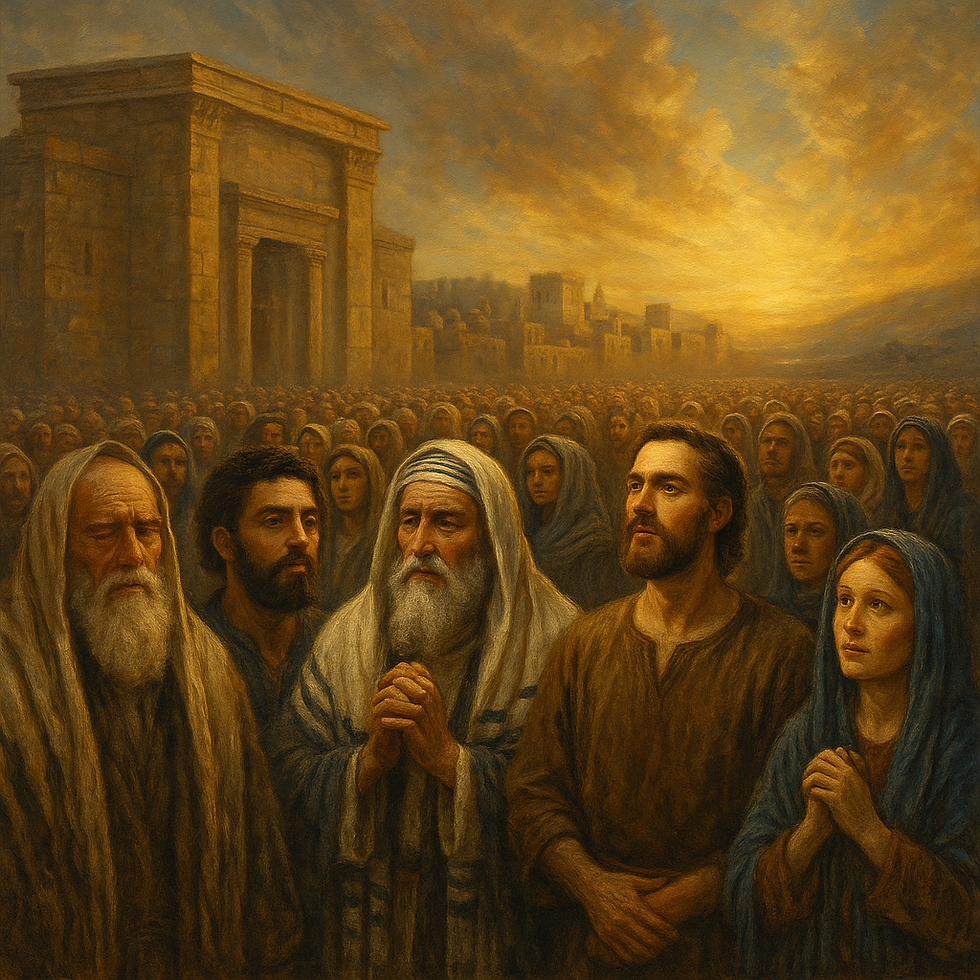
What began at Mount Sinai reached its spiritual fullness at Mount Zion, when the Spirit was poured out on the followers of Yeshua. Just as a mixed multitude gathered at Sinai to receive the Torah, so a multitude of nations gathered in Jerusalem to receive the Ruach HaKodesh on Shavuot (Pentecost).
Acts 2 tells us that Jews from every nation under heaven were present — Parthians, Medes, Elamites, Egyptians, Romans, Arabs — representing the same diversity that once stood at Sinai. And when Peter spoke, he declared that this outpouring was the very promise given through the prophets:
“And it shall come to pass in the last days, says God, that I will pour out My Spirit on all flesh.”(Joel 2:28; Acts 2:17)
The Torah given at Sinai was now being written on hearts. The covenant that began with Israel was expanding to include all who would believe — the spiritual continuation of that first mixed multitude.
Those early believers in Jerusalem lived the same pattern: They gathered daily in the Temple courts, broke bread in their homes, observed the Feasts, and walked in Torah.Non-Jews who came to faith in Yeshua didn’t form a new religion; they joined the community of Israel through the Messiah of Israel.
This was the rebirth of the mixed multitude — a living picture of what the prophets had spoken:
“Many nations shall join themselves to the Lord in that day and shall be My people.”(Zechariah 2:11)
The message of Zion was the same as the message of Sinai:Different nations — one covenant. Different languages — one Spirit. Different people — one new man in Messiah.
The First Believers: “The Way”
Long before the term Christian ever existed, the followers of Yeshua were known simply as “The Way” (Ha-Derekh) — a Jewish sect devoted to the teachings of the promised Messiah.Acts 24:14 records Paul’s words before the Roman governor Felix:
“According to the Way which they call a sect, I worship the God of our fathers, believing all things written in the Torah and the Prophets.”
These early believers were not outsiders to Judaism — they were its most faithful sons and daughters. They prayed in the synagogues, celebrated the Feasts of the Lord (Moedim), observed Shabbat, and continued to live in covenant faithfulness. Their faith in Yeshua was never seen as a new religion but as the continuation and fulfillment of the promises given to Israel.
In time, something remarkable happened: Gentiles began to come to faith in the God of Israel through Yeshua. The apostles saw this as the fulfillment of prophecy — the nations being grafted into the covenant promise.
The prophet Isaiah foresaw this moment:
“I will give you as a light to the nations, that My salvation may reach to the ends of the earth.” (Isaiah 49:6)
And Amos wrote:
“In that day I will raise up the fallen sukkah of David… that they may possess the remnant of Edom and all the nations who are called by My Name.” (Amos 9:11–12)
Acts 15 shows the Jerusalem council affirming that Gentiles were welcomed into Israel’s covenant community — purified by faith in the Messiah. They gathered in synagogues (Acts 15:21), learned Torah every Sabbath, ate kosher, and joined Jewish believers in prayer and fellowship.
In other words, the early Gentile believers lived a Jewish lifestyle of faith centered on Yeshua.
As Paul wrote:
“For He Himself is our peace, who has made the two one and has broken down the dividing wall… to create in Himself one new man.”(Ephesians 2:14–15)
The Apostolic Instruction for Gentiles
When Gentiles came into the faith, the apostles faced an important question: How do we welcome them? The answer came during the council of Jerusalem in Acts 15.
The early Jewish believers recognized that Gentiles were being filled with the same Ruach HaKodesh (Holy Spirit), so they discerned the guidance of Torah and prophecy rather than human tradition. James (Ya’akov) — the brother of Yeshua and leader of the community — declared:
“We should not make it difficult for the Gentiles who are turning to God. Instead, we should write to them to abstain from things polluted by idols, from sexual immorality, from what is strangled, and from blood.”(Acts 15:19–20)
This decree was not meant to replace Torah, but to give Gentiles a starting point — a foundation for holiness and worship that would separate them from pagan practices. Notice what follows in Acts 15:21:
“For Moses has been preached in every city from the earliest times and is read in the synagogues every Sabbath.”
This statement shows that the apostles expected Gentile believers to learn the rest of God’s instruction (Torah) over time — by joining Jewish believers in the synagogue and growing together in covenant life.
They Did Not Change Judaism — They Joined It
The first Non-Jew believers did not invent a new religion. They didn’t try to change the rules of Judaism or reject its rhythms. Instead, they adapted to the life of Israel as an act of worship to the God who had saved them through Yeshua.
They left behind idolatry, temple prostitution, and pagan festivals, and embraced the biblical calendar, the Sabbath, and kosher living as natural expressions of their new faith. They honored the roots of their salvation — not because they wanted to “become Jewish” for culture’s sake, but because the Spirit of Messiah was teaching them the same way of holiness that Israel had known since Sinai.
This was the beauty of The Way: Jews and Gentiles, united under one covenant, walking together in obedience, faith, and love. It was the living fulfillment of the words of the prophets.
“For My house shall be called a house of prayer for all nations.” (Isaiah 56:7)
The First Leaders Were All Jewish
Historical records — from the writings of Eusebius, Hegesippus, and early church fathers — tell us that the first fifteen bishops (or overseers) of Jerusalem were all Jewish and from the family of Yeshua Himself. The first was Ya’akov ha-Tzadik (James the Just), the brother of Yeshua, who led the community in Jerusalem after the resurrection (Acts 15).
Eusebius of Caesarea, quoting Hegesippus (2nd century CE), writes:
“The church of Jerusalem was at first composed of faithful Hebrews, until the siege of the city under Hadrian; the first fifteen bishops were of the circumcision.” (Ecclesiastical History, IV.5)
This community of Jewish believers kept the commandments, honored the Feasts, and prayed daily in the Temple courts — all while proclaiming that the Messiah had come. They saw no contradiction between being fully Jewish and fully devoted to Yeshua.
The Separation That Came Later
The tragic divide between Judaism and faith in Yeshua came generations later, not during the apostles’ time.After the destruction of the Second Temple (70 CE) and the Bar Kokhba revolt (132-135 CE), political and religious pressures forced the Messianic community into exile.Rabbinic authorities expelled believers in Yeshua from the synagogues, while emerging Gentile leaders in the growing “Church” began to abandon the Jewish roots of their faith — changing the calendar, distancing themselves from Shabbat, and eventually outlawing the Feasts.
What began as a Jewish movement rooted in Torah and prophecy was gradually redefined as a Gentile religion. The voices of Jewish believers — the descendants of “The Way” — were silenced or forgotten. Yet throughout history, from the apostles to modern rabbis, there have always been Jews who rediscovered that same truth: Yeshua is not the founder of another religion, but the fulfillment of Israel’s hope.
When we open the Book of Acts, we see Jewish men and women who believed in Yeshua while continuing to live as Jews. They prayed in the synagogues, kept the feasts, and were even described by outsiders as “a sect of Judaism” (Acts 24:5).Shaul (Paul) himself testified before the Sanhedrin:
“I am a Pharisee, the son of a Pharisee… I have done nothing against the people or the customs of our fathers.” (Acts 23:6; 28:17)
Faith in the Messiah was never meant to cancel Jewish identity — it was meant to complete it.

Rabbis Who Walked the Same Road
This struggle for identity isn’t new. It’s been part of our story since the first century, when the disciples of Yeshua — all Jewish men — stood before their leaders in Jerusalem declaring that the promises of the prophets had been fulfilled. From that moment on, every generation has produced Jewish voices who wrestled with the same tension: “Can I follow Yeshua and remain faithful to the covenant of my fathers?”
For many rabbis, the answer came through years of study, prayer, and inner conflict. Some found peace in embracing Yeshua while continuing to live within Jewish tradition. Others, facing rejection from their own communities, found themselves stepping into the broader body of Messiah — joining what became the Christian world.But no matter their path, their hearts burned with the same conviction: Yeshua is the promised Messiah of Israel.
These men were not rebels or heretics. They were teachers, scholars, and leaders who knew the Torah intimately — men who, in their search for truth, encountered the very One the Scriptures spoke about.
Let’s look at some of their stories.
Rabbis Who Found the Messiah: A Journey Through History
Throughout Jewish history, there have been rabbis, scholars, and spiritual leaders who, after deep study and personal revelation, came to recognize Yeshua (Jesus) as the promised Messiah of Israel. Some continued living as Jews within their traditions — observing Torah, Shabbat, and festivals — while others joined Christian denominations, often at great personal cost.Their stories remind us that the question of the Messiah is not foreign to Jewish thought, but central to it.
Rabbi Israel Zolli — Chief Rabbi of Rome (1940–1945)
Born Israel Zoller, Rabbi Zolli was one of the most respected Jewish scholars in Europe.During World War II, as Chief Rabbi of Rome, he witnessed the horrors of Nazi occupation and the courage of believers who risked their lives to save Jews.
After years of study and prayer, Zolli experienced what he described as a vision of Yeshua during Yom Kippur of 1944, hearing the words, “You are here for the last time.”In February 1945, he publicly confessed faith in Yeshua, taking the name Eugenio Maria Zolli.
In his memoir Before the Dawn, he wrote:
“When I came to know the Messiah, I realized that I had not ceased to be a Jew but had become a fulfilled Jew.”
His faith cost him his position and reputation, yet his writings continue to inspire seekers today.
Rabbi Daniel Solomon Zion — Chief Rabbi of Bulgaria
Rabbi Daniel Zion served as one of the senior rabbis of Bulgaria during the 1940s. During the Holocaust, he openly opposed Nazi orders and worked with Christian leaders to protect Jews from deportation.Messianic accounts record that he had a vision of Yeshua and came to believe that Yeshua was indeed the Messiah of Israel.
Even after immigrating to Israel, Rabbi Zion continued to live as a Jew — observing Shabbat, studying Torah, and teaching others about Yeshua.Though his belief was controversial, his courage and faith bridge the gap between Jewish heritage and Messianic conviction.
Rabbi Isaac Lichtenstein — Hungary, 19th Century
Rabbi Lichtenstein served as a respected rabbi for nearly forty years. After discovering the New Testament in his synagogue, he read it in secret and was astonished by its Jewishness and moral power.
He later wrote:
“I searched for thorns and found roses; I discovered pearls instead of pebbles.”
Lichtenstein never abandoned his Jewish identity — he refused baptism and continued to preach from the Torah while proclaiming Yeshua as the Messiah. His writings were widely circulated in both Hebrew and German and influenced generations of Jewish thinkers.
Rabbi Michael Solomon Alexander — Rabbi Turned Bishop of Jerusalem
Born in Germany to an observant Jewish family, Alexander studied to become a rabbi before encountering faith in Yeshua.After his conversion, he became the first Anglican Bishop of Jerusalem (1841), dedicating his life to reaching both Jews and Arabs with the message of the Messiah. His journey shows how Jewish scholars, even centuries ago, recognized the prophetic fulfillment in Yeshua.
Others Through the Ages
Over the past centuries, many lesser-known rabbis and scholars have quietly embraced faith in Messiah — some joining Christian denominations, others remaining within Jewish observance while privately following Yeshua.
Lists compiled by Messianic researchers mention names such as:
Rabbi Max Wertheimer
Rabbi Harold Vallins
Rabbi Samuel Isaac Joseph Schwarz
and others who blended Torah observance with faith in Yeshua.
Their testimonies — sometimes hidden, sometimes public — show that the Messianic movement is not a modern invention, but part of a continuous story within Israel.
A Living Faith
What unites all these men is not rebellion against Judaism, but a desire to fulfill it.They found in Yeshua the realization of what the prophets longed for — the Redeemer who brings forgiveness and restoration to Israel and the nations.Some took baptism and joined churches; others kept their tallit and tefillin and continued walking as Jews. But in every case, their hearts burned with the same conviction:
“We have found the One of whom Moses and the prophets wrote — Yeshua of Nazareth.” (John 1:45)
Conclusion
From the Chief Rabbi of Rome to humble teachers in small communities, many Jewish leaders have discovered that faith in Yeshua does not erase their identity — it completes it. Their lives stand as bridges between worlds that were never meant to be divided. And their stories continue to echo the ancient prayer of Israel:
“Baruch haba b’Shem Adonai — Blessed is He who comes in the Name of the Lord.”


Comments