
True Peace and the Mystery of Messiah
- Ely Hernandez

- Oct 18
- 5 min read
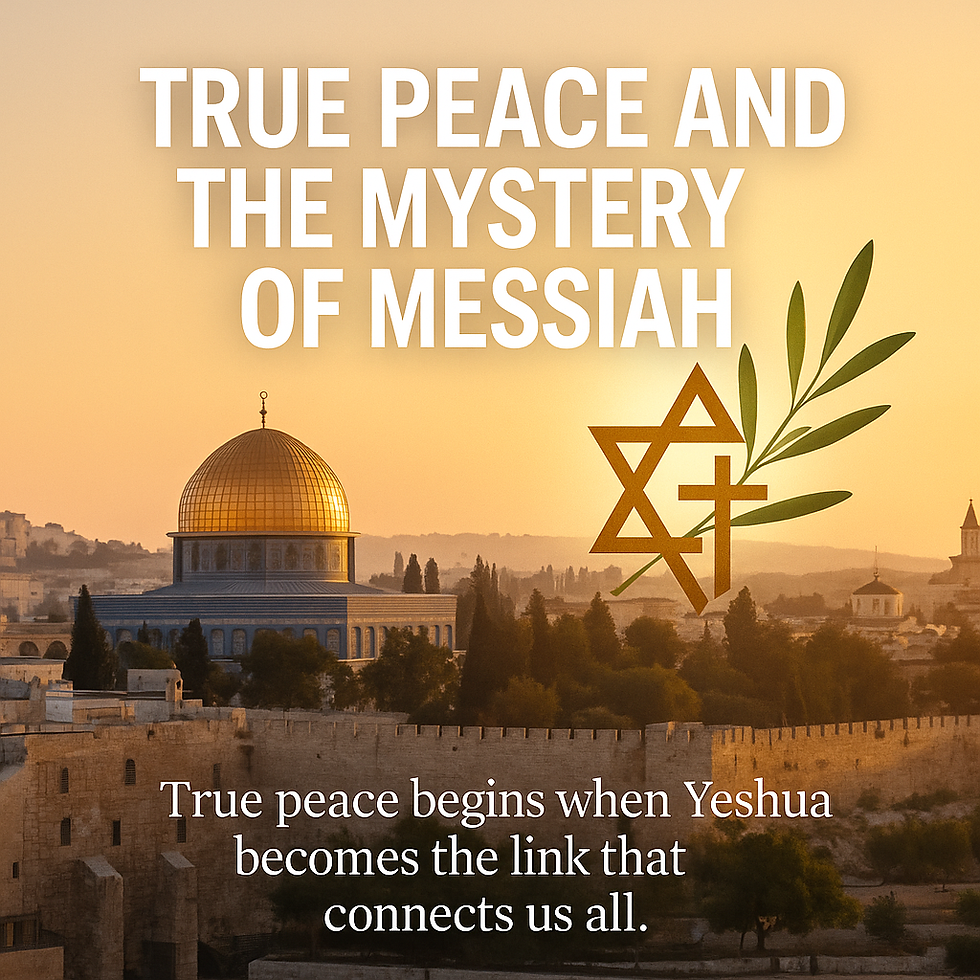
Why Yeshua — not war, politics, or prophecy — remains the only true path to peace
A World Still at War
In recent years, the Middle East has once again become a global symbol of unrest. From the devastating wars in Gaza and Israel, to the echoes of terrorism, uprisings in Lebanon and Syria, and the political turbulence surrounding Jerusalem — the “city of peace” has become the epicenter of conflict.
Each time war breaks out, countless voices rise predicting that this is the final battle — the one that will usher in the end of days. Many believers point to these wars as proof that only an apocalyptic second coming, a dramatic divine intervention, can bring peace to the world.
But is that what Scripture truly teaches? Must humanity wait for destruction to experience reconciliation?
The answer, according to the Word of God, is no.
The Fulfillment That Has Already Begun
Two thousand years ago, Yeshua HaMashiach — the promised Messiah — came to fulfill what the prophets had long declared. Daniel spoke of this Anointed One who would “bring an end to transgression, make atonement for sin, and usher in everlasting righteousness” (Daniel 9:24).
These weren’t abstract spiritual concepts. They were prophecies describing what the Messiah would do — and Yeshua did them. Through His death and resurrection, He reconciled heaven and earth, breaking the curse of sin and opening the way for humanity to live in restored fellowship with God.
1. “To bring an end to transgression”
Yeshua’s mission was to confront and conquer sin — not by force, but by reconciling humanity to God.
“You know that He appeared in order to take away sins, and in Him there is no sin.” — 1 John 3:5
“Behold, the Lamb of God who takes away the sin of the world.” — John 1:29
Through His obedience unto death, Yeshua ended sin’s dominion over all who believe (Romans 6:6–7). The curse of rebellion that began in Eden met its end at the cross.
2. “To make atonement for sin”
Daniel foresaw that the Messiah would cover iniquity — precisely what Yeshua accomplished through His atoning sacrifice.
“For Messiah also suffered once for sins, the righteous for the unrighteous, to bring you to God.” — 1 Peter 3:18
“Without the shedding of blood there is no forgiveness of sins… But now He has appeared once for all at the end of the ages to put away sin by the sacrifice of Himself.” — Hebrews 9:22, 26
The letter to the Hebrews reveals that Yeshua fulfilled the very purpose of the Temple. He became both the High Priest and the offering — the once-for-all atonement that reconciles humanity to the Father.
3. “To usher in everlasting righteousness”
Through Yeshua’s redemptive work, a new covenantal reality began — one defined by eternal righteousness rather than continual sacrifice.
“For our sake He made Him who knew no sin to be sin for us, so that in Him we might become the righteousness of God.” — 2 Corinthians 5:21
“By one sacrifice He has perfected forever those who are being sanctified.” — Hebrews 10:14
The righteousness Daniel foresaw was not a future moral age, but the righteousness that dwells in those who walk by the Spirit (Romans 8:1–4).
4. “To seal up vision and prophecy”
Daniel wrote that the Anointed One would “seal up vision and prophecy” — meaning to bring them to fulfillment.
“Do not think that I came to abolish the Torah or the Prophets; I did not come to abolish but to fulfill.” — Matthew 5:17
“All the promises of God find their Yes in Him.” — 2 Corinthians 1:20
Yeshua didn’t erase prophecy — He completed it. Every promise made through the prophets finds its fulfillment in Him.
5. “To anoint the Most Holy”
Finally, Daniel’s vision ends with the “anointing of the Most Holy.”
This points not to a rebuilt temple of stone, but to the living temple — the dwelling place of God within His people.
“The Word became flesh and tabernacled among us.” — John 1:14
“Do you not know that you are God’s temple and that God’s Spirit dwells in you?” — 1 Corinthians 3:16
Through Yeshua, God’s presence no longer rests behind a curtain — it abides in the hearts of those filled with the Ruach HaKodesh (Holy Spirit).
When He said, “It is finished,” He wasn’t predicting the end of the world — He was announcing the completion of redemption.
That redemption is the beginning of true peace.
The Mystery Understood by the Apostles
After His resurrection, the apostles began to understand a mystery that had been hidden for generations — that the Gentiles (the nations) were to be joined with Israel as one people through faith in Yeshua.
Paul called this the “great mystery of Messiah” (Ephesians 3:6), revealing that through the Spirit, all nations are grafted into the same olive tree (Romans 11).
This was radical — not a new religion, but the fulfillment of God’s promise to Abraham: “In you all nations of the earth will be blessed.”
The apostles saw that the Messiah had already broken down the wall between Jew and Gentile, slave and free, male and female. As Paul wrote:
“For you are all one in Messiah Yeshua.” (Galatians 3:28)
This is why the early followers of Yeshua were called the Way. They understood that through the Messiah, humanity had already been offered the path to peace.
Wars Cannot Produce Peace
History has shown that every treaty, truce, and negotiation in the Middle East eventually unravels. Leaders change, alliances shift, and blood is spilled again — Israelis and Arabs, Jews and Gentiles, one generation after another.
But Yeshua taught that peace is not born from politics or power, but from transformed hearts.
He said:
“My peace I give to you; not as the world gives, do I give to you.” (John 14:27)
The world seeks peace through compromise. Heaven offers peace through conversion of the soul — through the Spirit that reconciles humanity to its Creator and to one another.
Until people are connected through that same root, peace will remain an illusion.
The Role of Israel and the Nations
Israel remains central in God’s redemptive plan. Through Israel came the Torah, the prophets, and ultimately the Messiah Himself. Yet the purpose of Israel was never isolation — it was illumination.
As Isaiah proclaimed, “I will also make you a light to the nations, that My salvation may reach the ends of the earth” (Isaiah 49:6).
That light is Yeshua — the embodiment of God’s covenant love.
And when both Jew and Gentile recognize their place in Him, the hostility between them dissolves. The olive branches — native and wild — become one tree again.
The Path Forward: Linking Humanity to Yeshua
True peace cannot be legislated or enforced. It must be received — through the Messiah who already reigns.
When Yeshua becomes the link that connects all races, nations, and tribes, humanity finally begins to heal.
He is the bridge between heaven and earth, between Israel and the nations, between every heart longing for peace.
To believe that peace can only come after a future apocalypse is to overlook what God already accomplished through Yeshua two millennia ago.
Conclusion: The Kingdom That Already Reigns
Yeshua’s kingdom is not postponed; it is already among us — within the hearts of those who walk in His Spirit.
Every act of forgiveness, every reconciliation, every prayer for mercy is evidence of that invisible kingdom spreading through the world.
We do not wait for peace to descend from above. Heaven already descended once.
And His name is Yeshua — the Prince of Peace, the true link that connects us all.
Pull Quote for your website or social post:
“True peace begins not with treaties or borders, but when Yeshua becomes the link that connects us all.”
Comments